Call centers are no longer just rooms full of ringing phones. With modern 콜센터 AI 솔루션, they are becoming intelligent customer experience hubs that work faster, smarter, and more profitably than ever before. By improving customer service with virtual agent assist, repetitive questions are answered instantly, freeing agents to focus on high‑value conversations. These AI call center solutions driving omnichannel journeys ensure seamless, personalized experiences across every customer touchpoint.
Implementing call center AI solutions requires robust technology infrastructure capable of handling large-scale operations efficiently. Using advanced distributed computing networks for processing high volumes of real-time customer interactions enables AI systems to deliver accurate answers quickly, even during peak call times. Similarly, leveraging high-performance computing platforms to support complex AI algorithms for predictive analytics helps optimize call routing and automate repetitive tasks, freeing agents to focus on personalized support.
In addition to technology, integrating marketing strategies with AI insights can significantly enhance customer engagement. By using long-term strategies for improving online marketing campaigns through personalized AI-driven recommendations, companies can increase conversion rates and customer loyalty. Furthermore, adapting AI insights to create more effective content marketing and digital outreach strategies over time allows organizations to maximize the impact of every customer interaction, turning routine inquiries into opportunities for brand growth.
Financial planning also benefits from AI-driven insights in call centers. With comprehensive financial management strategies for allocating budgets and resources based on predictive AI data, companies can ensure optimal staffing, reduce operational costs, and maximize return on investment. By combining advanced technology, marketing intelligence, and financial foresight, call center AI solutions become a catalyst for operational efficiency and improved customer satisfaction.
The convergence of these elements transforms traditional call centers into smart, agile hubs where agents and AI work together seamlessly. Organizations that adopt these [call center AI solutions] can deliver faster responses, higher personalization, and more profitable interactions—setting a new standard for modern customer experience.
Top 10 Call Center AI Solutions for Modern Businesses
Finding the right call center AI solutions can transform your customer support operations, improve agent efficiency, and boost overall satisfaction. Here’s a curated list of the top providers, with Bright Pattern leading the way for its robust AI-driven features.
1. Bright Pattern – Intelligent AI Contact Center Solutions
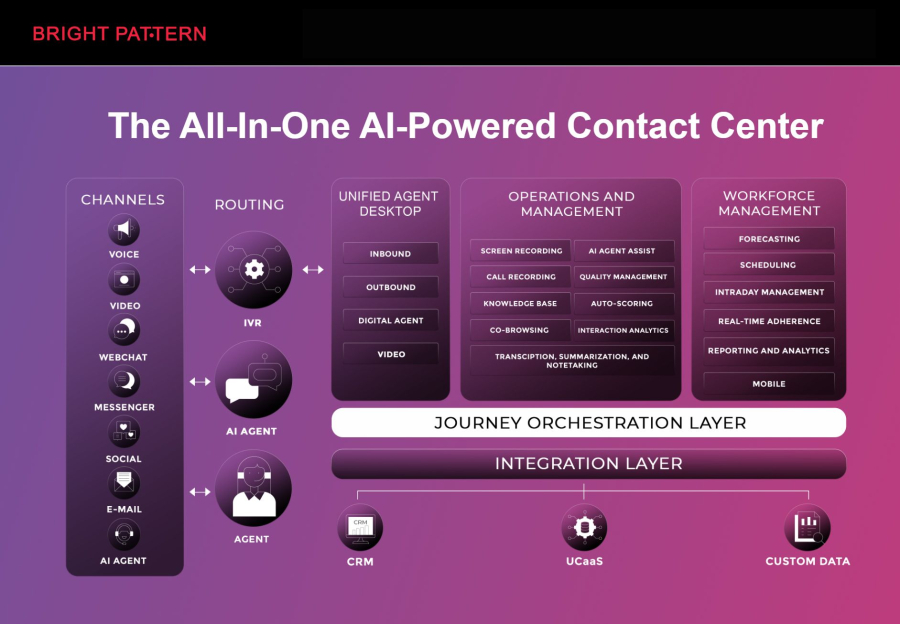
Bright Pattern stands out as a top choice for businesses seeking advanced call center AI solutions. It offers an omnichannel platform that integrates voice, chat, email, and social messaging into a single interface, enabling seamless customer interactions. AI-driven tools help agents handle high volumes of inquiries efficiently while delivering personalized experiences.
Key features of Bright Pattern include:
- AI-assisted call routing to connect customers to the right agent instantly
- Predictive analytics for better forecasting and performance insights
- Virtual agent support to handle repetitive queries automatically
- Omnichannel capabilities across voice, chat, email, and social messaging
- Real-time dashboards and reporting for operational visibility
This combination of features makes Bright Pattern ideal for businesses looking to modernize their customer experience and improve agent productivity with AI-powered tools.

2. Five9 – Cloud-Based AI Contact Center Platform
Five9 provides cloud-based call center solutions with AI integrations for predictive dialing, automated workflows, and real-time analytics. It is known for scaling efficiently for both small teams and large enterprises.
3. Genesys – AI-Powered Omnichannel Contact Center
Genesys offers AI-driven call center software designed to provide a seamless omnichannel experience. Its AI capabilities include sentiment analysis, automated responses, and workflow optimization.
4. Talkdesk – AI Contact Center Solutions for Enterprises
Talkdesk combines AI and cloud technology to deliver intelligent call routing, customer insights, and automated support, helping agents respond faster and more accurately.
5. NICE inContact – Next-Gen AI Contact Center
NICE inContact offers AI solutions that integrate with CRM systems, provide predictive analytics, and support intelligent virtual agents to enhance customer engagement.
6. RingCentral – AI Contact Center for Modern Businesses
RingCentral’s AI contact center solutions include speech analytics, AI-assisted routing, and omnichannel messaging, helping teams resolve issues efficiently.
7. 8x8 – AI-Enhanced Customer Engagement Platform
8x8 provides AI tools for sentiment analysis, automated call handling, and analytics dashboards, improving agent productivity and customer experience.
8. Vonage – AI Contact Center Technology
Vonage integrates AI into its cloud contact center solutions, enabling smart routing, virtual assistants, and analytics-driven performance insights.
9. Zendesk – AI Call Center Support
Zendesk’s AI-powered support tools include chatbots, AI recommendations, and predictive analytics to optimize call center workflows.
10. Cisco Contact Center – AI Solutions for Enterprise Support
Cisco Contact Center leverages AI for intelligent call routing, virtual agents, and advanced reporting to deliver faster, more accurate customer support.
What Are Call Center AI Solutions?
Call center AI solutionsare software tools that use artificial intelligence and machine learning to automate, assist, and improve customer interactions across voice and digital channels. They do not replace human agents; instead, they enhance what your team can accomplish in every interaction.
These solutions can handle tasks such as:
- Understanding and responding to customer speech and text in natural language.
- Routing calls and messages intelligently based on intent, priority, and skills.
- Providing agents with real‑time recommendations and next best actions.
- Automating routine workflows like identity verification, order status, or password resets.
- Analyzing conversations to uncover trends, compliance risks, and coaching opportunities.
The result is a contact center that is always on, consistently accurate, and able to scale without simply adding more headcount.
Key Benefits of Call Center AI Solutions
When implemented well, call center AI can deliver meaningful improvements across the entire customer journey and your internal operations.
1. Faster Service and Shorter Wait Times
AI‑powered virtual agents and intelligent IVR systems can handle a large share of common requests instantly. Customers can quickly complete simple tasks, while complex issues are passed to the right human agent with full context. This reduces queues, improves first‑contact resolution, and keeps customer frustration low.
2. Higher Customer Satisfaction and Consistent Experiences
AI systems follow your best practices every time. They provide consistent, policy‑aligned responses and can personalize answers based on customer history, previous interactions, and account data. Customers feel recognized and valued, not forced to repeat information from one agent to another.
3. Empowered Agents and Reduced Burnout
Instead of searching through dozens of knowledge base articles or systems while a customer waits on hold, agents can rely onreal‑time AI assistancethat surfaces relevant information, suggests replies, and even drafts follow‑up messages. This reduces cognitive load, shortens handle times, and makes the job less stressful and more rewarding.
4. Lower Operating Costs and Scalable Support
Because AI can handle a large portion of high‑volume, low‑complexity interactions, your team can support more customers without a proportional increase in staffing. Automation frees agents to focus on revenue‑generating tasks, complex problem solving, and relationship building.
5. Better Insights and Data‑Driven Decisions
Every call, chat, and message is a source of insight. Call center AI solutions can automatically transcribe, classify, and analyze conversations to uncover:
- Recurring customer issues and root causes.
- Product feedback and feature requests.
- Compliance or script adherence patterns.
- Training and coaching opportunities for agents.
Instead of relying on small samples and manual reviews, you gain a complete and objective view of your contact center performance.
Core Capabilities of Modern Call Center AI
Although platforms differ, most leading call center AI solutions share a core set of capabilities that work together to improve both customer and agent experiences.
1. Conversational IVR and Virtual Agents
Conversational IVRuses speech recognition and natural language understanding to let customers speak in their own words instead of navigating long menus. Virtual agents can:
- Recognize the customer intent from voice or text.
- Authenticate users using data from your CRM or account systems.
- Resolve common inquiries end to end, such as balance inquiries or order tracking.
- Seamlessly transfer to a human agent with full context preserved.
This creates a smoother, more natural experience than legacy keypad‑driven IVR systems.
2. AI‑Assisted Agent Tools
Agent assist tools run in the background during live interactions and provide actionable guidance, including:
- Real‑time suggestionsfor responses, troubleshooting steps, and upsell opportunities.
- Automatic summarizationof calls or chats for faster wrap‑up and accurate records.
- Knowledge recommendationsthat surface the most relevant articles or procedures.
- Compliance nudgesthat remind agents to read required disclosures or obtain consent.
This enables agents to deliver consistent, high‑quality service with less effort and training time.
3. Intelligent Routing and Workforce Optimization
AI can analyze each incoming interaction and determine the best destination based on factors such as customer intent, complexity, sentiment, language, and agent skills. Over time, it learns which agents and queues deliver the best outcomes for specific types of inquiries, improving:
- First‑contact resolution rates.
- Average handle times.
- Customer satisfaction scores.
- Agent utilization and workload balance.
4. Speech Analytics and Quality Monitoring
AI‑powered speech analytics can automatically process large volumes of recorded calls to identify patterns, keywords, emotions, and outcomes. Instead of manually reviewing a small sample of interactions, supervisors can see trends across all calls and drill down into specific areas such as:
- Why customers are calling and which issues are growing or shrinking.
- Which scripts and offers are most effective.
- Where compliance risks or policy deviations occur.
- How top‑performing agents handle difficult situations.
5. Knowledge Management and Self‑Service
AI can also improve your knowledge base and self‑service channels by:
- Identifying content gaps based on real conversations.
- Recommending updates when policies or products change.
- Powering search and chatbot experiences that feel natural and intuitive.
Customers get faster answers, and agents spend less time hunting for the right information.
Typical Use Cases for Call Center AI Solutions
Call center AI is flexible and can be applied to many scenarios across industries. Below are common use cases where organizations see strong benefits.
Customer Support and Service
- Handling account balances, order status, shipping updates, and appointment reminders.
- Providing step‑by‑step troubleshooting for technical issues.
- Supporting multilingual customers with real‑time translation assistance.
- Proactively informing customers about outages, delays, or known issues.
Sales and Revenue Generation
- Qualifying leads using virtual agents before handing them to a sales representative.
- Recommending relevant products or upgrades during service calls.
- Automating follow‑up messages and appointment scheduling.
Collections, Billing, and Renewals
- Reminding customers about upcoming payments or renewals.
- Offering self‑service payment options via voice or chat.
- Helping negotiate simple payment plans within your policies.
Internal Support (IT Help Desk and HR)
- Answering common IT questions like password resets or software access.
- Guiding employees through HR procedures and policy questions.
- Routing more complex issues to specialists with complete context.
How AI Transforms the Call Center Experience: Before and After
The impact of AI is easiest to understand when comparing traditional call centers with AI‑enhanced operations.
| Area | Traditional Call Center | AI‑Enhanced Call Center |
| Customer Onboarding | Complex menus, long wait times, repeated information. | Natural language IVR, quick authentication, context preserved. |
| Agent Support | Manual search across multiple systems. | Real‑time suggestions, unified knowledge, instant summaries. |
| Quality Monitoring | Limited manual call reviews. | Automated analysis of many or all interactions. |
| Scalability | Requires proportional increases in staff. | Automates routine volume, staff focused on complex work. |
| Customer Experience | Inconsistent, depends heavily on individual agents. | More consistent, personalized, and data‑informed. |
Implementation Roadmap: How to Roll Out Call Center AI Successfully
Successful AI adoption is not about turning on technology overnight; it is about a thoughtful, phased approach that aligns with your goals, data, and people.
1. Define Clear Objectives and Metrics
Begin by clarifying what you want to improve with AI. For example:
- Reduce average handle time on specific call types.
- Increase self‑service completion rates.
- Improve customer satisfaction for certain journeys.
- Enhance compliance monitoring and reduce manual audits.
Define measurable targets so you can track progress and refine your approach.
2. Map Customer Journeys and Identify High‑Impact Use Cases
Review your most common interaction types and customer journeys. Look for processes that are:
- High volume but relatively simple and standardized.
- Repetitive and time‑consuming for agents.
- Critical to customer satisfaction, such as billing questions or order tracking.
These are often ideal candidates for early AI automation and assistance.
3. Prepare and Organize Your Data
AI performance depends heavily on the quality of the data it can access. To get ready:
- Consolidate call recordings, chat logs, and transcripts where possible.
- Standardize labels for call reasons, dispositions, and outcomes.
- Ensure your knowledge base is current, accurate, and well structured.
- Clarify which systems will provide customer and account data.
4. Start With a Pilot and Iterate
Rather than deploying AI across every channel at once, start with a well‑defined pilot project such as:
- AI‑assisted suggestions for a single support queue.
- A virtual agent handling a limited set of common inquiries.
- Speech analytics for a specific product line or region.
Use this pilot to learn, adjust conversation flows, refine training data, and build internal confidence before expanding.
5. Engage and Enable Your Agents
Agents are critical to the success of call center AI. Involve them early by:
- Explaining how AI will assist, not replace, their work.
- Gathering feedback on which tasks feel most repetitive or frustrating.
- Providing training on new tools and workflows.
- Celebrating improvements such as faster resolutions or reduced after‑call work.
When agents see AI as a helpful partner, adoption and performance both improve.
6. Monitor, Optimize, and Expand
Once live, continuously monitor your AI solution using the metrics defined earlier. Review:
- Completion rates for automated flows.
- Customer satisfaction on AI‑assisted journeys.
- Agent feedback on tools and suggestions.
- Accuracy of transcription, routing, and intent detection.
Use this insight to fine‑tune prompts, improve knowledge content, and safely expand AI coverage to additional channels and use cases.
Choosing the Right Call Center AI Solution
The right platform depends on your size, industry, regulatory requirements, and existing technology stack. However, several evaluation criteria are useful for most organizations.
1. Core Features and Use Case Fit
Confirm that the solution supports the functions you need most, such as:
- Conversational IVR and virtual agents for voice and digital channels.
- Real‑time agent assistance and knowledge recommendations.
- Speech analytics, transcription, and quality monitoring.
- Intelligent routing and workforce optimization.
2. Integration With Existing Systems
Call center AI delivers more value when it can securely connect to systems such as:
- Customer relationship management platforms.
- Ticketing and case management systems.
- Billing and order management tools.
- Current telephony and contact center platforms.
Look for solutions with proven integrations and flexible application programming interfaces.
3. Data Security, Privacy, and Compliance
Customer conversations often contain sensitive information. Evaluate each solution's approach to:
- Data encryption in transit and at rest.
- Access controls and audit logging.
- Retention policies for recordings and transcripts.
- Support for region‑specific privacy and data protection regulations.
4. Ease of Use and Administration
Consider how easily your teams can:
- Design and update conversation flows and IVR logic.
- Manage knowledge content and training data.
- Configure routing rules and skills‑based distribution.
- Access analytics dashboards and build custom reports.
User‑friendly tools reduce your dependence on external support and speed up continuous improvement.
5. Scalability and Future‑Readiness
Your call center AI needs to evolve with your business. Assess whether the platform can:
- Handle increasing interaction volume without major redesigns.
- Support new channels such as messaging apps or social platforms.
- Leverage improvements in underlying AI models over time.
Best Practices for Maximizing Value From Call Center AI
To get the strongest results from call center AI solutions, focus on a combination of technology, process, and culture.
Align AI With Clear Business Outcomes
Connect every AI initiative to specific business outcomes such as cost savings, revenue growth, or experience improvements. This keeps projects focused and helps you prioritize enhancements that deliver the greatest impact.
Design Human‑Centered Experiences
Ensure AI interactions feel natural and respectful. For example:
- Let customers easily reach a human when they prefer or when the issue is complex.
- Be transparent that they are interacting with an automated system.
- Avoid overly long or rigid menus; use natural language to guide the conversation.
Invest in Training Data and Knowledge Quality
AI systems learn from the data and content you provide. High‑quality transcripts, well‑labeled intents, and up‑to‑date knowledge articles are critical. Regularly review and refine your content so AI responses remain accurate and useful.
Use Feedback Loops From Agents and Customers
Encourage agents to share where AI suggestions help and where they fall short. Collect customer feedback on self‑service experiences. Use this real‑world input to guide improvements and identify new opportunities for automation or assistance.
Measure and Communicate Wins
Track metrics such as reduced handle times, improved satisfaction scores, or increased self‑service usage. Share these results with stakeholders and frontline teams so they can see the benefits of AI in concrete terms. Visible wins build momentum for further innovation.
The Future of Call Center AI
Call center AI is evolving quickly. Emerging trends include:
- More natural conversationsas language models continue to improve.
- Deeper personalizationbased on customer preferences and behavior across channels.
- Proactive supportthat anticipates needs and reaches out before customers contact you.
- Tighter integrationwith analytics, marketing, and product teams to share insights across the organization.
Organizations that embrace AI thoughtfully today will be better positioned to offer standout customer experiences and operate more efficiently tomorrow.
Conclusion: Turning Your Call Center Into a Strategic Advantage
Call center AI solutions are more than a technology upgrade; they are a strategic shift in how you serve customers, support your agents, and grow your business. By combining intelligent automation with human empathy, you can deliver faster, more personalized service at scale while reducing operational costs and empowering your team.
With a clear vision, the right platform, and a thoughtful rollout plan, your call center can evolve from a cost center into a powerful driver of loyalty, insight, and long‑term value.
